Home > Lithium difluoro(oxalato)borate(LiDFOB)
Lithium difluoro(oxalato)borate(LiDFOB)
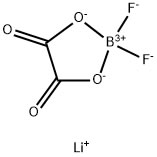
Lithium difluoro(oxalato)borate
Synonyms:LiDFOB; LiODFB; 2,2-Difluoro-4,5-dioxo-1,3,2-dioxaborolane Lithium Salt
CAS No.:409071-16-5
EINECS No.:803-919-2
Molecular Formula:C2BF2O4·Li
Molecular Weight:143.77
Structure Formula:
Standard:
|
Items |
Specifications |
|
Appearance |
White powder |
|
Purity(GC) |
≥99.9% |
|
Insoluble matter |
≤500ppm |
|
Moisture |
≤300ppm |
|
Free acid (as HF) |
≤100ppm |
|
SO42- |
≤10ppm |
|
Cl- |
≤10ppm |
|
Fe |
≤5ppm |
|
K |
≤10ppm |
|
Na |
≤10ppm |
|
Ca |
≤10ppm |
|
Cr |
≤1ppm |
|
Ni |
≤2ppm |
Properties:Lithium difluoro(oxalato)borate (LiODFB) is a white crystalline powder under normal conditions; Melting point: 265-271℃, Moiling point: 275.3℃ (102kPa), Mensity: 2.01-2.12g/cm³ (20℃), Vapor pressure as low as 0.003Pa at 20-25℃, and almost non-volatile at room temperature; this substance has strong hygroscopicity, and when exposed to an environment of 25℃ and 50% humidity, it rapidly absorbs moisture to form a monohydrate (LiODFB·H₂O), followed by a spontaneous irreversible hydrolysis reaction to generate complex compounds. It exhibits good solubility in organic solvents such as carbonates, ethers, and γ-butyrolactone, especially in mixed alkyl carbonate solvents, where a solubility concentration of 1mol/L can be achieved in the range of -50℃ to 100℃; its thermal decomposition temperature is approximately 240℃, and its thermal stability is superior to that of lithium hexafluorophosphate (LiPF₆) but lower than that of lithium bis(oxalato)borate (LiBOB)..
Applications:Lithium difluoro(oxalato)borate (abbreviated as LiODFB, CAS No.: 409071-16-5) is a high-performance and multifunctional material in the field of lithium-ion batteries, with core applications focusing on electrolyte modification and electrode material optimization, as detailed below:
1.) Lithium-ion battery electrolyte film-forming additive: As a core film-forming agent, its fluorine atoms and oxalate groups act synergistically to form a dense and stable solid electrolyte interphase (SEI) film rich in LiF and borides on the electrode surface, while constructing a boron-containing CEI film on the cathode surface. It effectively inhibits electrolyte decomposition, passivates the aluminum current collector, reduces lithium dendrite formation and lithium source consumption by the SEI film, and significantly improves battery cycle stability (e.g., the capacity retention rate of NCM811||Li batteries reaches 83% after 200 cycles), high-temperature performance (30% improvement in cycle performance at 60℃), and wide temperature range adaptability. It is compatible with various electrode materials such as graphite, silicon, and lithium metal, suitable for high-voltage (above 4.4V) battery systems, and the electrochemical stability window can be expanded to approximately 5.5V.
2.) Alternative electrolyte conductive salt: It can be used as a substitute conductive salt for traditional lithium hexafluorophosphate (LiPF₆), maintaining high ionic conductivity (4.6 mS/cm) over a wide temperature range of -40℃ to 60℃. Even at an ultra-low concentration of 0.16M, it can still maintain normal battery operation, solving the pain points of high cost and high viscosity of traditional high-concentration electrolytes. Additionally, it exhibits superior thermal stability (decomposition temperature >240℃) and hydrolysis resistance, avoiding the generation of highly toxic HF and enhancing the environmental friendliness of the electrolyte.
3.) Electrode composite material modifier: It is coated on the surface of composite anode materials such as SiO/C through in-situ crystallization deposition. By virtue of its film-forming properties, it enhances the structural stability of the electrode, provides a buffer for the volume expansion of SiO materials, and simultaneously improves electrode conductivity and interface compatibility, extending the service life and high-low temperature cycle performance of battery materials. Relevant modification technologies have been applied in patents.
4.) Adaptability to multi-scenario battery systems: It is mainly applied in power batteries (e.g., ternary high-nickel battery NCM811), and adding 5%-10% can increase the high-temperature cycle capacity retention rate from 70% to 85%, while supporting stable discharge in extreme cold environments of -40℃. It is also expanded to the energy storage battery field, reducing the operation and maintenance costs of outdoor energy storage systems by virtue of its wide temperature adaptability. Furthermore, exploratory applications have been carried out in liquid electrolytes for solid-state batteries, sodium-ion batteries, and lithium metal batteries with ether-based electrolyte systems, achieving remarkable results.
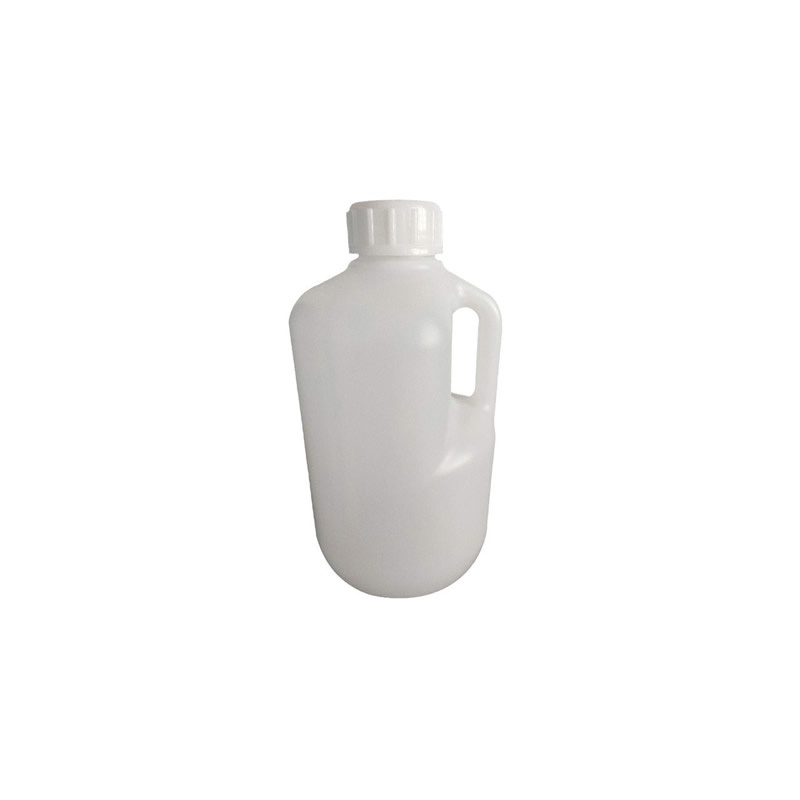
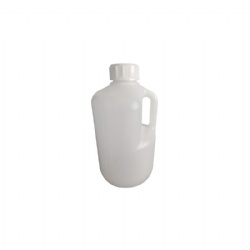
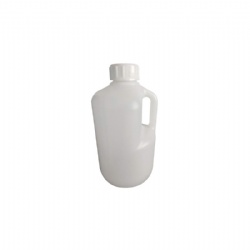
Packing:5kg HDPE bottle
Products Category
Latest News
Contact Us
Tel: +86-561-3306168 / 3308168
Fax: +86-561-3308168
Mobile: 13905616951
E-mail: [email protected]
Add: No.20, Wutong Middle Road, Longhu Industrial Park, Economic Development Zone, Huaibei, Anhui, China.
CHINESE
ENGLISH


Mail inquiry